
 Gifts

Waterproof jewelry 2026 — the guide for summer, beach & vacation
Waterproof jewelry 2026 — the guide for summer, beach & vacation
By Iris Lehmann · 17 June 2026 · Reading time approx. 11 minutes
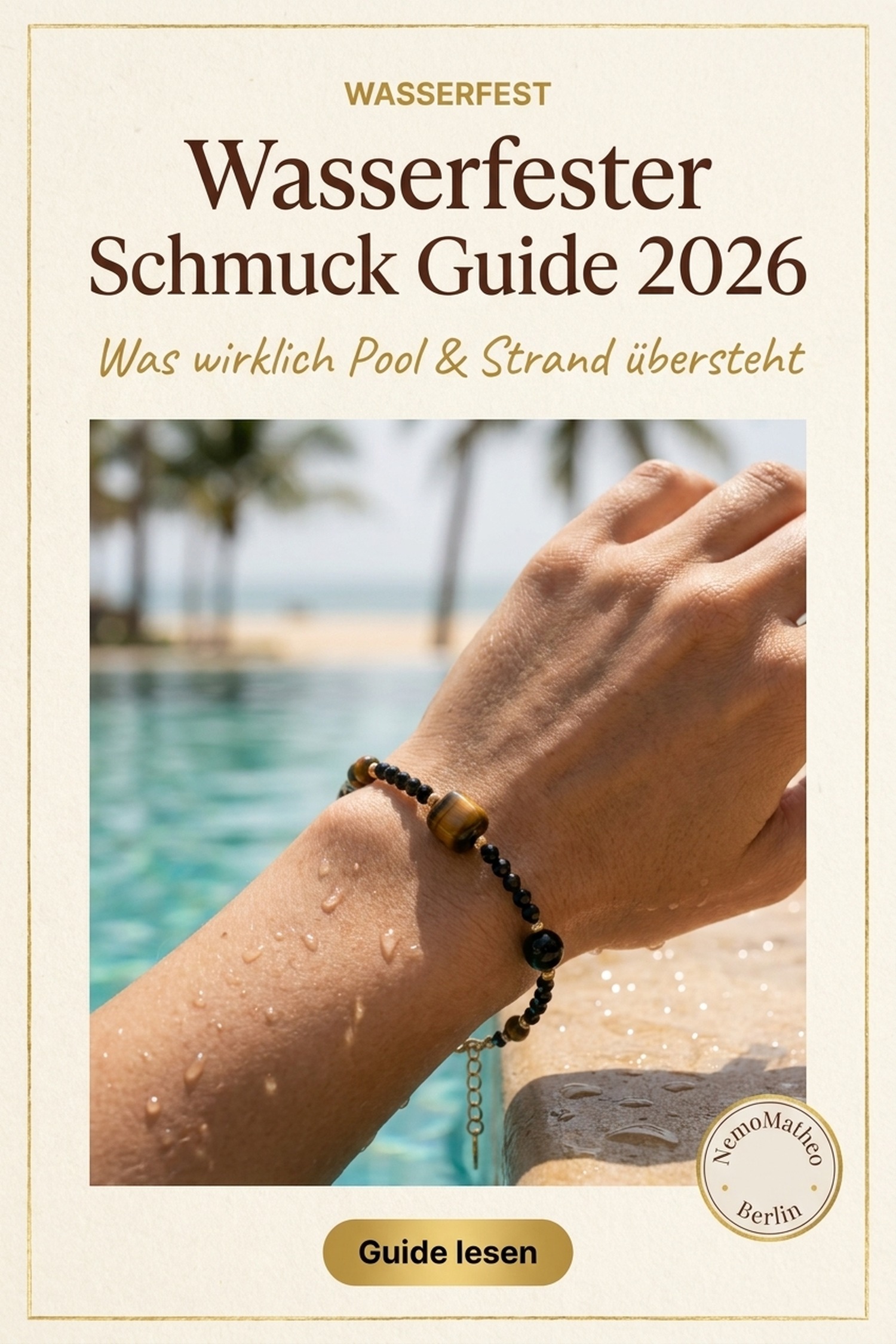
Image: Summer layering made of 18K gold-plated stainless steel and Natural Stone — waterproof tested for pool, sea, and beach days.
In short: Genuine waterproof jewelry survives frequent water contact without tarnishing, discoloring, or losing color. The gold standard in the affordable segment is 18K gold-plated stainless steel. With natural stone, the mineral determines whether the pool, sea, or sauna are unproblematic. This guide shows you which material truly withstands what — and which pieces let you wear your summer 2026 without worries.
Quick Facts — waterproof jewelry at a glance
- Waterproof ≠ water-resistant: The term means resistance to repeated water contact, not dive capability according to IP standards.
- 18K gold-plated on stainless steel is the only truly waterproof plating method in the price segment under 100 € — everything else is usually just galvanically thin plated.
- Natural stone differentiates by mineral: Tiger's Eye and obsidian are robust, freshwater pearls are sensitive to chlorine.
- SummerCare rule of thumb: rinse with clean freshwater and pat dry after every swim day — this doubles the lifespan of the gold plating.
- 2-year warranty on gold plating is offered by NemoMatheo on all 18K stainless steel pieces under normal use.
Table of Contents
- What does "waterproof" actually mean for jewelry?
- Material gold standards for waterproof jewelry
- Natural stone in water — what really happens?
- Our 6 waterproof bestsellers for summer 2026
- Waterproof jewelry on vacation — pool, beach, sauna
- Care for your waterproof jewelry
- FAQ
What does "waterproof" actually mean for jewelry?
"Waterproof" is not a standardized term in the jewelry context like an IP protection class for electronics — and this is exactly where most confusion arises. When we at NemoMatheo talk about waterproof jewelry, we mean: The piece withstands repeated water contact without the surface tarnishing, discoloring, or the gold plating looking visibly worn. This includes hand washing, showering, sweating in the summer, and occasional swimming in the pool or sea.
To be distinguished from this are two other terms: Water-resistant strictly speaking means that no impairment occurs even under pressure (such as diving at a depth of several meters) — this is a feature of watches with IP classification, not of jewelry. Splash-proof in turn only describes protection against occasional drops, such as when washing dishes, and applies to inferior gold-plated fashion goods.
In everyday life, waterproof jewelry specifically means for you: You can wear the necklace to the beach day, not take off your bracelet in the hotel pool, and not fear damage from sweat during sports. What you should avoid, however, is contact with aggressive chemicals like very high concentrations of chlorine, sunscreen directly on the gold plating when applying, or the sauna with freshwater pearl jewelry. More on this in the next chapters. If you want to dive deeper into how 18K gold plating technically works, read our 18K Gold-Plated Stainless Steel Jewelry Guide.
An important rule of thumb for defining terms: In the EU, manufacturers may not use the term "waterproof" arbitrarily — it must be proven by coating thickness tests and salt spray tests (DIN EN ISO 9227). Reputable brands specify in the product details which load was tested. If this information is missing, skepticism is warranted: Marketing language with "water-repellent" or "splash-proof" in the jewelry context often means that the piece is precisely not approved for actual water contact.
Material gold standards for waterproof jewelry

Not every "gold-colored" piece is also waterproof — the material decides. Here are the four most important material groups in the price segment up to 200 €, with an honest rating:
1. 18K gold-plated on stainless steel 316L
This is today's standard in the mid-premium segment and our recommendation for anyone looking for truly waterproof jewelry at an everyday price. The gold plating is applied to surgical stainless steel via PVD or galvanic processes in a thickness of 1,5 to 2,5 micrometers. This stainless steel core practically does not corrode and offers the gold plating perfect adhesion. Practically speaking, this means: Pool, sea, shower, and sweat are no problem, the surface remains stable for years. Details on the process can be found in the linked Complete Guide to 18K Gold Plating.
2. Sterling Silver 925
Real silver generally tolerates water contact well — it does not corrode. But: Silver tarnishes. Sulfur-containing compounds in air and sweat lead to the typical dark layer (silver sulfide). In summer vacation with lots of salt water and sunscreen, this happens all the faster. Sterling silver is therefore not waterproof in the strict sense, but requires care. If you want the bright shine, you should polish regularly.
3. Real Gold (14K / 18K solid)
Solid gold is naturally waterproof — gold does not oxidize. However, prices even for a delicate 14K bracelet usually start at 300 € upwards, and higher karats are softer and thus more prone to scratches in everyday life. For pure vacation pieces, solid gold is often a shame — the blend "18K gold-plated on stainless steel" delivers visually nearly identical results at a fraction of the price.
4. Plated or gold-plated without stainless steel core
Caution is advised here: Much of what is sold cheaply as "gold-plated" is a thin layer of gold on brass or zinc alloys. These corrode under water, and the gold plating often peels off visibly after five to ten washes. If the product description does not clearly say "on stainless steel 316L", the piece is very likely not truly waterproof.
Natural stone in water — what really happens?

With natural stone jewelry, it gets more differentiated, because every mineral has its own Mohs hardness, porosity, and chemical sensitivity. Here is a practical overview from our Natural Stone Jewelry Main Collection:
Freshwater pearls — the sensitive beauty
pearls consist of aragonite crystals embedded in an organic conchiolin matrix. Exactly this organic component makes them vulnerable: Chlorine in the pool and salt water in the sea dry out the surface, and the typical pearlescent shine becomes dull. Sunscreen and perfume are also poison. Rule of thumb: Pearl jewelry is gorgeous at the beach during the day, but remove it before water contact. Fresh water for rinsing hands is okay.
Tiger's eye, obsidian, and lapis lazuli — the robust ones
These three minerals have a Mohs hardness of 5,5 to 7 and are densely structured. They tolerate fresh and salt water without problems and are even worn in many cultures as protective stones while swimming. Tiger's eye often shows its chatoyance — the characteristic light reflex — even more intensely after drying. These stones are our clear recommendation for beach vacations.
Moonstone and aventurine — careful with temperature shock
Both have a fine crystalline structure with micro-planes. They are waterproof, but sensitive to rapid temperature changes — so do not jump into the cold sea right after sunbathing. Otherwise, micro-cracks can form that dampen the shimmering play of light of the moonstone in the long run.
Rose quartz — fresh water yes, sun preferably not
Rose quartz tolerates water without problems. What harms it, however, is intense UV radiation over a long period: The delicate pink color can fade after years of direct sun. For occasional beach use this is negligible, for daily summer wear on the outside we would prefer other stones.
Our 6 waterproof bestsellers for summer 2026
From our assortment, we have selected six pieces that our female customers have taken with them most frequently as vacation and summer companions over the past two summers — and that pass the stress tests without exception. All combined from 18K gold-plated stainless steel or with robust natural stones.
1. Eclipse Bracelet — Tiger's Eye & Obsidian
The Eclipse bracelet with tiger's eye and obsidian is our waterproof recommendation number one for beach vacations. Both stones are extremely robust, the setting made of 18K gold-plated stainless steel does not corrode. The earthy amber tone of the tiger's eye meets the deep black of the obsidian — perfect for sun-tanned skin. Also popular with men as a unisex layering piece.
2. Pure Pearl Harmony — Freshwater Pearl Bracelet
Classically elegant: Pure Pearl Harmony Bracelet with hand-selected freshwater pearls. Important: This piece does not belong in salt water, but for dinner at the beach or a sundowner by the pool, it is unbeatable. The stainless steel clasp and the gold-colored spacers are 18K gold-plated and handle the climate without any problems.
3. Golden Sun Necklace — Lifestyle Layering
The Golden Sun Lifestyle Chain is a delicate 18K gold-plated chain that we designed explicitly for active wearers. Surfing, SUP, pool, sauna — everything goes. The filigree look allows it to be worn with a bikini or summer dress without looking overdressed. Our bestselling waterproof layering piece.
4. Freshwater Pearl Bracelet — Pure Pearl Harmony Variant
A second variant of the freshwater pearl bracelet with slightly larger, baroque pearls. Same care principle as above: remove before pool and sea, after that it is the most elegant summer accessory of all. Popular as a gift.
5. Moonlight Natural Stone Bracelet with Freshwater Pearl
The Moonlight Bracelet combines moonstone with a single freshwater pearl as an accent. Moonstone is temperature-sensitive, so do not go directly into cold water after sunbathing — otherwise a robust piece that looks good all summer long. A prettier alternative to pure pearl pieces for the active day.
6. Ocean Kiss Pearl Necklace with Starfish
The Ocean Kiss Pearl Necklace with Starfish Pendant is our most thematically fitting summer necklace. Freshwater pearls here as well — so deliberately not for swimming, but a highlight for every beach walk, beach photo, and beach dinner. The gold-plated starfish is 18K and waterproof.
You can find more summer pieces in our Gemstone Jewelry Collection — all waterproof natural stone bracelets are bundled there. For that World Cup summer feeling at the pool or during public viewing — such as game night in the garden or spontaneous public viewing at the hotel pool — feel free to check out the World Cup 2026 Fan Jewelry Collection.
Waterproof jewelry on vacation — pool, beach, sauna

Each holiday environment brings different chemical and physical stress. Here is an honest overview of what works where and what is better left at home:
Pool Holiday (Chlorine and Bromine): Chlorinated pool water is the greatest stressor for gold plating. 18K gold-plated stainless steel withstands this, but appreciates being rinsed off afterwards. Freshwater pearls and organic materials do not belong in pool water. Tiger's eye, obsidian, and lapis lazuli tolerate chlorine without any problems.
Beach Holiday (Saltwater): Saltwater is surprisingly gentler than chlorine — 316L stainless steel is explicitly seawater-resistant. Still, rinse with freshwater after a day at the beach so no salt crystals remain in fine links, which later cause micro-abrasion. Sand between chain links is the underestimated enemy long-term, not the salt.
Sauna (Heat and Sweat): Stainless steel with 18K gold plating tolerates sauna temperatures easily. Natural stone jewelry with organic components (pearls, amber, coral) should stay outside — heat and intense sweat can damage them. Moonstone too, because of the temperature shock in alternating baths.
Urban Summer (Sweat and Sunscreen): The underestimated stress. Sunscreen often contains oils and filtering agents that can attack gold plating over months. Tip: Put jewelry on after applying sunscreen, not before. Sweat is unproblematic for our material combinations.
Gym and Sports: Also permanently a question of material. 18K gold-plated stainless steel is safe during weight training, although dumbbells and equipment occasionally leave micro-scratches on the gold plating — those who value a high-gloss finish prefer to remove delicate chains for training. Not an issue during yoga, pilates, and cardio. In the swimming pool after sports, the pool rule applies again: remove pieces with freshwater pearls beforehand.
Outdoor Adventure (Hiking, Mountain Lake): Hiking sports are uncritical for all waterproof materials. At wild mountain lakes with mineral-rich water, however, a matte patina can develop over years — not a defect, rather a slight character trait that many wearers even like. Polishing with a microfiber cloth brings back the original shine within seconds.
Care for your waterproof jewelry
Even waterproof jewelry thanks you when you treat it to a small daily routine — this easily doubles its lifespan:
- After every water contact briefly rinse with clear freshwater and pat dry with a soft cloth (glasses microfiber is perfect).
- Never use abrasive cleaners or toothpaste — the gold plating is only a few micrometers thin and mechanical wear is the most common cause of damage.
- Store dry and ideally individually so pieces don't scratch each other. A soft fabric pouch per piece is ideal.
- For natural stone regularly check whether the stones are seated firmly in their setting — sand and sweat can attack adhesives over years.
You can find the complete care instructions with step-by-step routines for each material in our Jewelry Storage Cleaning Care Guide.
FAQ
Is 18K gold-plated jewelry really waterproof?
Yes — when the gold plating is applied to 316L stainless steel and in a thickness of at least 1,5 micrometers (ideally 2 to 2,5 µm). This combination easily withstands showers, swimming in the pool, sweating in the summer, and occasional saltwater. Caution with cheap fashion items: "gold-plated" without specifying the base material is often just on brass or zinc — and then not waterproof.
Can I go swimming with pearl jewelry?
We clearly advise against it. Freshwater pearls consist of aragonite and the organic conchiolin matrix — chlorine and saltwater attack precisely this organic component. The typical pearly luster becomes dull, and in extreme cases small cracks can form on the surface. Freshwater for hand washing is okay, but for the pool and sea it is better to remove pearls and store them safely in a soft pouch.
Does waterproof jewelry break in the sauna?
18K gold-plated stainless steel tolerates sauna temperatures (typically 80 to 100 °C) without issues. Robust natural stones like tiger's eye and obsidian do as well. What does not belong in the sauna: pearls, amber, coral, moonstone (temperature shock in alternating baths), and anything with adhesive bonds, as heat weakens the adhesive over time.
How long does the gold plating last with regular water contact?
For 18K gold-plated stainless steel with a proper layer thickness, you can expect three to five years of visibly flawless gold plating with daily wear including showering, swimming, and sports. With simple care (rinsing, drying) even longer. NemoMatheo gives a two-year warranty on the gold plating under normal use — but our experience shows that most pieces stay beautiful significantly longer.
Which natural stone is the most robust for beach holidays?
Tiger's eye is our absolute beach holiday champion: Mohs hardness 7, dense and non-porous, tolerates salt and freshwater, and the light effect (chatoyancy) looks fresh after every wash. Closely followed by obsidian (volcanic glass, very smooth and chemically inert) and lapis lazuli (Mohs hardness 5 to 5,5, robust against water). You can wear these three carefree all vacation long.
Ready for summer?
If you are now looking for the matching waterproof piece for your summer 2026, discover our Natural Stone Jewelry Collection for the summer with all robust tiger's eye, obsidian, and lapis lazuli bracelets — handcrafted in Germany, 18K gold-plated, with a two-year warranty. You won't want to take the pieces off.
Note: written with the help of AI, editorially reviewed. · Last update: 2026-06-17 · Iris Lehmann, NemoMatheo
July Birthstone 2026 — Onyx & Black Gemstones as a Jewelry Gift Guide
Germany Jersey 2026—Fan Outfit & Jewelry Styling for the World Cup
Related Posts

Schmuck verschenken, ohne die Ringgröße zu kennen: vier Kaufvarianten

Bunte Natursteinketten kombinieren: Farbe und Länge zusammen wählen

Edelstein-Armband: Welche Länge passt zu deinem Handgelenk?

Perlenohrringe zu kurzen Haaren und Brille: fünf Varianten vergleichen

Schmuck-Adventskalender gemeinsam schenken: Budget und Auswahl planen

Schmuck-Adventskalender oder einzelnes Schmuckgeschenk: Was passt besser?

Schmuckset verschenken: Fertiges Set oder selbst kombinieren?
